Ad placement reserved for chapter sponsors, education tools, test prep platforms, and student offers.
Carbon and its Compounds Notes
This chapter explains why carbon forms such a large number of compounds, how covalent bonding works, what homologous series and functional groups mean, and how compounds such as ethanol, ethanoic acid, soaps, and detergents are connected to everyday life.
- 8 min read
- 35 practice questions
- Aligned to CBSE 2025–26 syllabus
- 100% free · no login
- Updated Aug 2026
Reserved space for student-focused ads, learning tools, scholarships, and exam prep promotions.
Why Carbon is Special
Carbon is special because it shows tetravalency and catenation. Tetravalency means carbon forms four covalent bonds, and catenation means carbon atoms can link with one another to form chains, branches, and rings. These two features create an enormous variety of compounds.
Because carbon compounds are so widespread, they appear in fuels, food, medicines, plastics, fibres, and biological molecules. This makes the chapter highly relevant to everyday life and also very common in board exams. Students who understand the logic of bonding usually find the rest of the chapter much easier.
A common mistake is to memorise formulas without understanding why carbon needs four bonds. The stable electronic configuration idea should always be kept in mind. Carbon shares electrons because gaining or losing four electrons would be energetically difficult.
Simple Examples to Understand Carbon Quickly
Think of LPG in the kitchen, petrol in vehicles, candle wax, sugar, paper, plastic bottles, and cotton cloth. All of them are built from carbon compounds in one form or another. This one list itself shows why the chapter matters so much in real life.
A very easy example of tetravalency is methane, CH4. One carbon atom joins with four hydrogen atoms, so students can literally count four bonds and see why carbon is called tetravalent. Once methane is understood, larger carbon compounds stop looking mysterious.
For catenation, imagine beads joined in a chain. Carbon atoms can join in a similar way to form straight chains, branched chains, or rings. This simple picture makes the word catenation much easier to remember than a definition alone.
Covalent Bonding in Carbon
Carbon compounds mainly involve covalent bonding, which means atoms share electrons instead of transferring them completely. Molecules such as methane, ethane, oxygen, and water are explained through shared pairs of electrons. This is different from ionic bonding studied in the previous chapter.
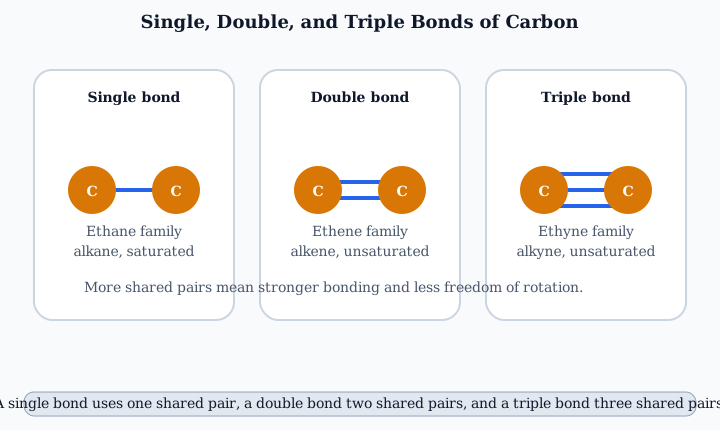
Single, double, and triple bonds are important because they affect formula, structure, and chemical behaviour. Ethane has a single bond between carbon atoms, ethene has a double bond, and ethyne has a triple bond. Unsaturated compounds contain double or triple bonds.
Board answers score well when students mention shared electron pairs and then name the bond type. A labelled structural sketch is often more helpful than a long paragraph. Clear bonding diagrams also prevent confusion between saturated and unsaturated compounds.
Saturated and Unsaturated Hydrocarbons
Hydrocarbons are compounds made of carbon and hydrogen only. Saturated hydrocarbons have only single bonds and are called alkanes, while unsaturated hydrocarbons contain double or triple bonds and are called alkenes and alkynes. This classification is fundamental for the reactions asked later in the chapter.
Saturated compounds generally undergo substitution reactions, whereas unsaturated compounds often undergo addition reactions. Students should connect bond type with reaction type rather than treating the topics separately. This reduces memorisation and strengthens reasoning.
When asked to identify a compound family, look first at the bond between carbon atoms. One quick look at the structural formula often gives the answer immediately. That is why drawing or recognising the structure is a high-value skill in this chapter.
Homologous Series and Nomenclature
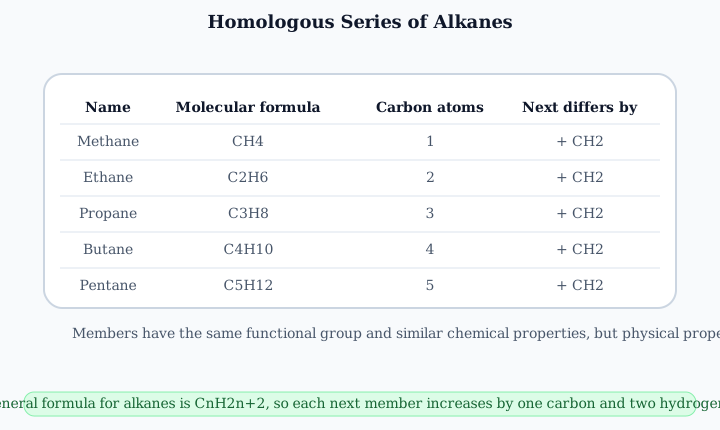
A homologous series is a family of compounds with the same functional group and similar chemical properties. Consecutive members differ by a CH2 unit and show gradual change in physical properties such as boiling point. Alkanes, alkenes, alcohols, and carboxylic acids are standard examples.
Names such as methane, ethane, propane, and butane come from the number of carbon atoms. Once students see the pattern, nomenclature becomes much easier. The chapter does not demand advanced organic naming, but it does expect clear recognition of common prefixes and suffixes.
This topic is often tested through pattern-based one-mark questions. Students should revise the first few members carefully and learn the general formulas. The pattern then becomes easier to extend during exams.
Functional Groups
Functional groups are atoms or groups of atoms that determine the characteristic reactions of an organic compound. Alcohols contain the -OH group, aldehydes contain -CHO, ketones contain >C=O, and carboxylic acids contain -COOH. The functional group changes the behaviour of the compound strongly.
For board purposes, students should be able to identify a functional group from a formula and name the family correctly. They should also know that compounds with the same functional group show similar chemical behaviour. This idea is the organic equivalent of pattern recognition in inorganic chemistry.
A common mistake is to confuse alcohol with carboxylic acid because both contain oxygen and hydrogen. The ending of the name and the group present must both be checked. Ethanol and ethanoic acid belong to completely different functional groups.
Chemical Properties: Combustion, Oxidation, Addition, and Substitution
Most carbon compounds are combustible and burn in oxygen to give carbon dioxide, water, heat, and light. This is why fuels such as LPG, CNG, petrol, diesel, kerosene, and biogas are carbon compounds. Clean combustion and smoky combustion are often used to compare fuel quality.
Unsaturated compounds undergo addition reactions in which hydrogen or other atoms add across a multiple bond. Saturated hydrocarbons generally undergo substitution reactions, especially in the presence of sunlight. Oxidation of alcohols and related compounds is also important in this chapter.
The chapter becomes easier when students classify reactions using structure. If there is a double bond, addition is likely; if there is a saturated hydrocarbon in sunlight with chlorine, substitution is likely. Such reasoning helps in board questions even when the exact example changes.
Ethanol and Ethanoic Acid
Ethanol is an alcohol with the formula C2H5OH, and ethanoic acid is a carboxylic acid with the formula CH3COOH. Ethanol is widely used as a solvent and in sanitiser formulations, while ethanoic acid is present in vinegar. These two compounds are the most important named members in the chapter.
Ethanoic acid reacts with sodium hydrogencarbonate to release carbon dioxide, which helps distinguish it from ethanol. Ethanol can be oxidised to ethanoic acid under suitable conditions. Such conversions are common in 3-mark questions.
Students should remember that pure ethanoic acid freezes in winter-like conditions around 290 K, giving it the name glacial acetic acid. This is a classic textbook detail. One line about use plus one line about property usually makes the answer complete.
Esters and Saponification
Esters are sweet-smelling compounds generally formed by the reaction of a carboxylic acid with an alcohol in the presence of concentrated sulphuric acid. This reaction is called esterification. Fruity smells and flavouring examples are used to make the topic memorable.
The reverse process, alkaline hydrolysis of esters, is called saponification when it is used to make soap. This links organic chemistry directly with soap manufacturing. Students often score well here because the process feels concrete and familiar.
Board answers should mention the pleasant smell of esters and the role of concentrated sulphuric acid as a dehydrating catalyst in esterification. That combination covers both observation and chemistry. It also helps distinguish the reaction from simple mixing.
Soaps and Detergents
Soaps are sodium or potassium salts of long-chain carboxylic acids. They clean because one end of the molecule is hydrophilic while the long hydrocarbon tail is hydrophobic. This dual nature helps trap oily dirt inside structures called micelles.
Soaps do not work well in hard water because calcium and magnesium ions form insoluble scum. Detergents, however, can work in hard water, which is why they are often preferred in modern washing products. This difference is one of the standard comparison questions in the chapter.
The chapter is closely linked to daily life because every student has seen soap lather and detergent powders in use. A strong answer explains micelle formation and then mentions hard water behaviour. That covers both concept and application.
Common Mistakes and Board Answer Template
Students often confuse covalent compounds with ionic compounds and saturated compounds with unsaturated compounds. Another very common mistake is mixing ethanol and ethanoic acid because their names sound similar. Structure and functional group should always be checked before answering.
For a 5-mark answer, write the definition first, then the formula or equation, then the key reason, and finally one use or property. For soap questions, explain micelles and hard water. For carbon-bonding questions, mention tetravalency and catenation early.
The best revision strategy is to group this chapter by patterns: bonding, hydrocarbon family, functional group, and named reactions. That reduces fear and turns organic chemistry into a series of linked ideas.
Practice and Revision
Test your understanding with quick chapter-level practice.
Chapter Q&A
Why does carbon not usually form ionic compounds?
Carbon would need to gain or lose four electrons, which is difficult, so it usually forms covalent bonds by sharing electrons.
What is the easiest way to spot an unsaturated compound?
Look for a double bond or triple bond between carbon atoms.
Why are esters important in this chapter?
They connect equations with observation because they have pleasant smells and are formed in a named reaction.
Do all carbon compounds burn?
Many carbon compounds are combustible, but the reaction conditions and completeness of burning can vary.
Why is ethanoic acid called acidic?
It releases hydrogen ions in aqueous solution and shows acidic behaviour with indicators and bases.
Why does soap form scum?
Soap reacts with calcium and magnesium ions in hard water to form insoluble salts called scum.
What should I memorise from homologous series?
Remember the pattern of names, formulas, and the CH2 difference between consecutive members.
Can detergents replace soaps completely in explanations?
No. The chapter expects students to compare both and explain why detergents perform better in hard water.
Ad slot placed after the chapter body so reading flow is never interrupted.
This inventory appears across Class 9 and Class 10 notes so ads remain visible throughout the study journey.