Ad placement reserved for chapter sponsors, education tools, test prep platforms, and student offers.
Metals and Non-Metals Notes
This chapter explains how metals and non-metals differ in properties and reactions, why the reactivity series matters, how ionic compounds are formed, how ores are converted into useful metals, and why corrosion control matters in everyday life and industry.
- 8 min read
- 35 practice questions
- Aligned to CBSE 2025–26 syllabus
- 100% free · no login
- Updated Aug 2026
Reserved space for student-focused ads, learning tools, scholarships, and exam prep promotions.
Physical Properties of Metals and Non-Metals
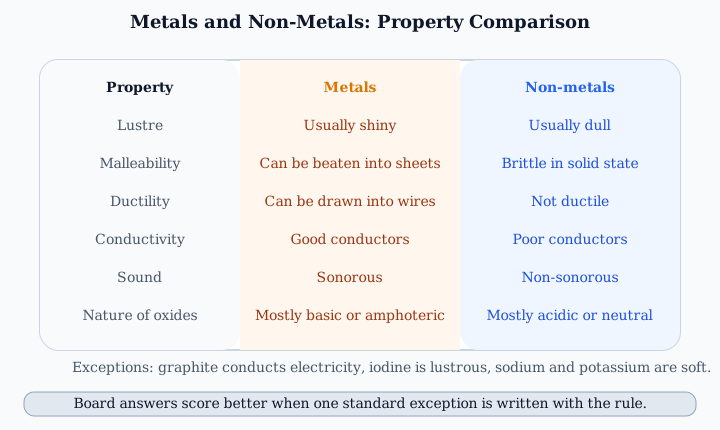
Metals are generally lustrous, malleable, ductile, sonorous, and good conductors of heat and electricity. Non-metals are usually dull, brittle, non-sonorous, and poor conductors. These general rules are important, but the chapter also expects students to remember standard exceptions.
Sodium and potassium are soft enough to be cut with a knife, mercury is a liquid metal, graphite is a non-metal that conducts electricity, and iodine is a lustrous non-metal. Good board answers state the rule and then add one exception. That style shows both memory and understanding.
Indian examples make the topic easier to picture. Copper wires in homes show conductivity, aluminium utensils show malleability, and charcoal shows that many non-metals are brittle and not shiny. The chapter often begins here but later moves quickly into chemical reactivity.
Simple Examples from Daily Life
Take a copper electric wire and a small piece of coal. The copper wire can bend without breaking and can carry electricity, while the coal piece breaks easily and cannot be drawn into a wire. This simple comparison helps students remember ductility and conductivity without learning the words mechanically.
Now think of an aluminium foil used to wrap food or cover a tiffin item. It can be pressed into a thin sheet very easily, which is exactly what malleability means. A non-metal such as sulphur or charcoal cannot be beaten into thin sheets like that.
A steel spoon gives a clear ringing sound when struck lightly, which helps in recalling that metals are sonorous. On the other hand, a piece of coal or chalk does not produce that kind of metallic sound. Such familiar comparisons make the chapter much less dry.
Reaction with Oxygen
Metals react with oxygen to form metal oxides, and non-metals react with oxygen to form non-metal oxides. Many metal oxides are basic, while many non-metal oxides are acidic. This distinction is used repeatedly in classification and reasoning questions.
Magnesium burns with a dazzling white flame to form magnesium oxide, which is basic in nature. Sulphur burns to form sulphur dioxide, which dissolves in water to give an acidic solution. These examples help students connect oxide formation with acid-base behaviour.
Students should not say that every metal oxide is purely basic. Aluminium oxide and zinc oxide are amphoteric and react with both acids and bases. That single exception is a very useful scoring point.
Reaction with Water
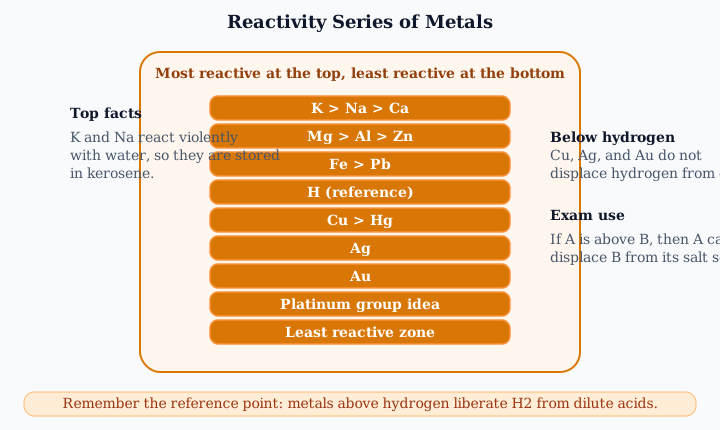
Different metals react with water at different rates, and this is where the reactivity series becomes practical. Potassium and sodium react violently with cold water, calcium reacts less vigorously, magnesium reacts slowly, and iron reacts mainly with steam. Less reactive metals such as copper, silver, and gold do not react with water in ordinary conditions.
Highly reactive metals are stored in kerosene because contact with air and moisture can cause dangerous reactions. This is a direct textbook point and appears regularly in one-mark questions. Students should remember both the reason and the safety measure.
The board trick is to compare the speed and conditions of reaction, not just memorise yes or no. Writing that iron reacts with steam but not cold water under ordinary conditions shows much better understanding than a single-word answer.
Reaction with Dilute Acids and the Reactivity Series
Metals above hydrogen in the reactivity series can displace hydrogen from dilute acids. Metals below hydrogen, such as copper, silver, and gold, do not do so. This rule helps students predict whether a reaction will happen before even writing the equation.
The reactivity series also explains displacement reactions between metals and salt solutions. A more reactive metal can displace a less reactive one from its salt solution, which is why zinc displaces copper from copper sulphate. Such questions test reasoning rather than memory alone.
A strong answer should mention the position of the metal relative to hydrogen or to the displaced metal. Simply writing reaction occurs is incomplete. The reason based on reactivity is usually an important marking point.
Ionic Bonding and Ionic Compounds
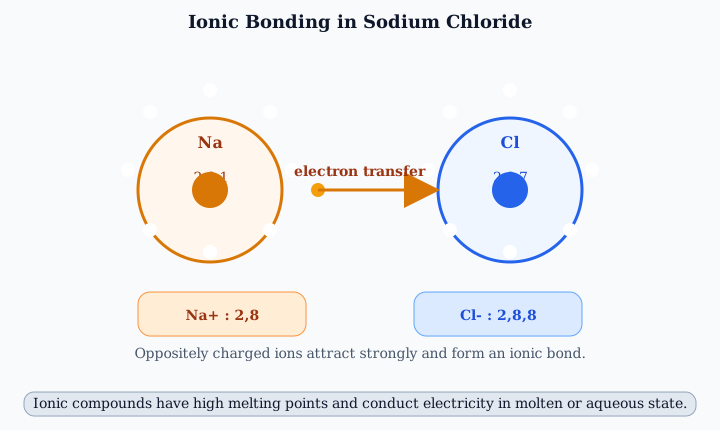
Metals usually lose electrons to form cations, while non-metals gain electrons to form anions. The electrostatic attraction between oppositely charged ions forms an ionic bond. Sodium chloride is the textbook model used to explain this process clearly.
Ionic compounds usually have high melting and boiling points because the attraction between ions is strong. They are generally soluble in water and conduct electricity in molten state or aqueous solution because ions can move freely then. In the solid state, ions are fixed and electrical conduction does not take place.
The easiest way to answer ionic bonding questions is to show electron transfer, final ions, and one property of ionic compounds. Students often forget the last step and lose easy marks. A labelled diagram makes the explanation much clearer.
Occurrence of Metals, Minerals, and Ores
Most metals are not found in the free state because many of them are reactive. They occur in nature as minerals, and those minerals from which metals can be extracted profitably are called ores. Gold and platinum are among the few metals often found in native form because they are very unreactive.
This distinction matters in board questions because students often use mineral and ore interchangeably. Every ore is a mineral, but not every mineral is an ore. Writing that clearly can turn a weak answer into a complete one.
The extraction route depends on the reactivity of the metal. Highly reactive metals are extracted by electrolysis, moderately reactive metals are extracted by reduction of oxides, and low-reactivity metals may be obtained by heating or simple chemical reduction. This overview links the whole chapter together.
Extraction of Metals and the Blast Furnace
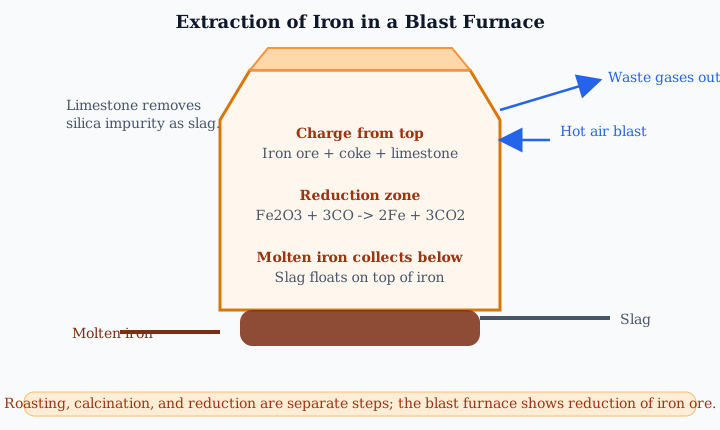
Before reduction, concentrated ores may undergo roasting or calcination to remove volatile impurities and convert sulphides or carbonates into oxides. Roasting means heating in excess air, while calcination means heating in limited or no air. Students should always distinguish these two processes carefully.
Iron is extracted in a blast furnace from its oxide ore. Coke helps in reduction by forming carbon monoxide, and limestone helps remove silica impurities by forming slag. The process is a standard long-answer question because it combines raw materials, reactions, and products.
In board answers, mention charge from the top, hot air blast, reduction of ore, slag formation, and molten iron collection. That five-step structure covers the important marking points. If space permits, a labelled diagram strengthens the answer.
Corrosion, Prevention, and Alloys
Corrosion is one of the most practical topics in the chapter because it affects bridges, tools, pipes, machines, and household items. Rusting is the best-known example, but silver tarnishes and copper develops a green coating too. The process wastes money and weakens useful materials.
Metals can be protected by painting, oiling, greasing, galvanising, electroplating, anodising, or alloying. Stainless steel is corrosion-resistant because it is an alloy, and galvanised iron is protected by a zinc coating. These named methods are frequently asked in exams.
Students should not write paint and galvanisation as if they are identical. Painting provides a physical barrier, while galvanisation gives a protective zinc coating that also sacrifices itself first. This difference is worth noting in 3-mark answers.
Uses of Metals and Non-Metals
Metals are used in electrical wiring, cooking utensils, machinery, construction, and transport because of conductivity, strength, and malleability. Non-metals are used as fuels, fertiliser components, disinfectants, and essential elements in living systems. The chapter wants students to connect properties with uses, not list uses randomly.
Copper is used in wires because it conducts electricity well, aluminium is used in foil and utensils because it is light and malleable, and oxygen is vital for respiration. Chlorine is used in water purification, which connects chemistry to public health. These examples make property-based questions easy to answer.
When a question asks why a material is used for a purpose, name the property directly. For example, write copper is used for wiring because it is a good conductor and can be drawn into thin wires. Property plus use is the board-scoring pattern.
Common Mistakes and Board Answer Template
Students often mix up lustre with hardness, ore with mineral, and roasting with calcination. Another repeated mistake is forgetting the exceptions such as graphite conducting electricity or zinc oxide being amphoteric. Such details may look small but they separate average answers from high-scoring ones.
For long answers on reactivity or extraction, write the rule first, then the equation, then the reason, and finally the use or implication. For ionic bonding, write electron transfer, ion names, and one property. This sequence keeps the answer orderly and easy to mark.
The safest board template for this chapter is: definition, example, equation, reason, and exception. If the question is process-based, replace exception with a final application point. That structure works especially well for corrosion, reactivity, and extraction questions.
Practice and Revision
Test your understanding with quick chapter-level practice.
Chapter Q&A
Why are metals usually found as ores?
Because many metals are reactive and combine with other substances in nature instead of remaining free.
Can a non-metal be shiny?
Yes. Iodine is a non-metal but it is lustrous.
Why is graphite special?
Graphite is special because it is a non-metal that conducts electricity.
What is the easiest way to use the reactivity series?
Check whether the metal is above or below hydrogen, or above or below the metal in the salt solution.
Why is zinc coating protective?
Zinc blocks contact with air and moisture and also corrodes before iron, giving extra protection.
Do all metals react with acids?
No. Metals below hydrogen, such as copper and silver, do not react with dilute acids to liberate hydrogen.
Why is iron extraction asked so often?
It brings together ore, reduction, slag formation, and industrial application in one standard process.
What should I revise last from this chapter?
Revise the property exceptions, the reactivity series, ionic compound properties, and the named corrosion-prevention methods.
Ad slot placed after the chapter body so reading flow is never interrupted.
This inventory appears across Class 9 and Class 10 notes so ads remain visible throughout the study journey.