Ad placement reserved for chapter sponsors, education tools, test prep platforms, and student offers.
Electricity Notes
Comprehensive Class 10 Science notes on electricity — electric charge, current, potential difference, Ohm's law, resistance and resistivity, factors affecting resistance, series and parallel resistor combinations with equivalent resistance, Joule's law of heating, electric power, commercial unit of electricity (kilowatt-hour), domestic electric circuits, safety devices including fuse, MCB, and earthing. Includes full numerical practice with step-by-step solutions.
- 13 min read
- 31 practice questions
- Aligned to CBSE 2025–26 syllabus
- 100% free · no login
- Updated Aug 2026
Reserved space for student-focused ads, learning tools, scholarships, and exam prep promotions.
Why Electricity Is the Most Numerical Chapter
Electricity is the most calculation-intensive chapter in Class 10 Physics. Every formula here can generate a 3-mark or 5-mark numerical, and the theory questions also carry high marks. Board exam patterns show that from this chapter alone, students can expect: Ohm's law numericals, series/parallel equivalent resistance, heating effect calculations, electric power and energy-bill problems.
The key to scoring full marks in this chapter is systematic numerical writing — always list given values with units, write the formula, substitute step-by-step, and state the final answer with the correct unit. Never skip a step in board answers.
Simple Examples Before the Formula Work
Think of water flowing through a pipe. If more water passes through every second, the flow is greater. Electric current can be understood in a similar simple way as the amount of charge flowing through a wire each second.
A cell in a torch pushes charge through the circuit just as a water pump pushes water through a pipe. If the switch is open, the torch does not glow because the path is broken. This home example makes the meaning of a complete electric circuit very easy to grasp.
A glowing electric bulb and a running ceiling fan are both everyday signs that current is flowing and electrical energy is being used. Once students connect formulas to such familiar objects, the chapter starts feeling practical instead of purely numerical.
Electric Charge and Electric Current
All matter is made of atoms. Atoms have a positively charged nucleus (protons) and negatively charged electrons orbiting around it. Normally, an atom is neutral — equal positive and negative charges. When electrons are transferred from one body to another, one body becomes positively charged (loses electrons) and the other becomes negatively charged (gains electrons). Electric charge is measured in coulombs (C). The charge of one electron is −1.6 × 10⁻¹⁹ C.
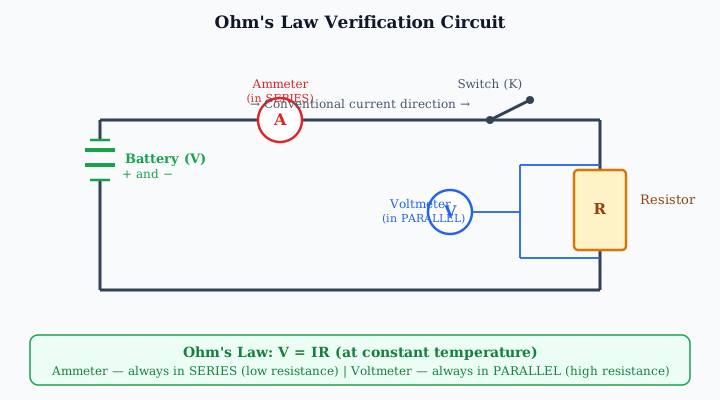
Electric current is the rate of flow of electric charge through a conductor. When a cell or battery is connected to a wire, the electric field created by the cell drives free electrons through the wire. The direction of conventional current is from the positive terminal of the battery, through the external circuit, to the negative terminal — opposite to the direction of electron flow. Current is measured by an ammeter, which must always be connected in series with the component.
In metals, current is carried by free electrons. In electrolyte solutions (like CuSO₄ in electroplating), current is carried by positive and negative ions. In gases, current is carried by both ions and electrons.
Potential Difference and Electric Circuit
Water flows from a higher level to a lower level due to difference in height (gravitational potential difference). Similarly, electric current flows from a higher electric potential to a lower electric potential — driven by the potential difference (also called voltage) between two points.
The potential difference between two points in a circuit is defined as the work done in moving a unit positive charge from one point to the other. It is measured by a voltmeter, which must always be connected in parallel with the component across which voltage is to be measured. A voltmeter has very high resistance so that it draws negligible current.
A cell or battery maintains a potential difference (called electromotive force or EMF) between its terminals, which drives current through the circuit. An electric circuit is a complete, closed conducting path through which current can flow. If the path is broken anywhere (open circuit), current stops. The circuit includes the source (battery), conducting wires, components (bulbs, resistors), and a switch.
Ohm's Law — Statement, Graph, and Limitations
Ohm's law states that at constant temperature, the current I flowing through a conductor is directly proportional to the potential difference V applied across its ends. This means the ratio V/I is constant and is called the resistance R of the conductor.
The V-I graph for an ohmic conductor (one that obeys Ohm's law) is a straight line passing through the origin. The slope of the V-I graph (when V is on the y-axis and I on the x-axis) equals the resistance R. A steeper slope means higher resistance.
Ohm's law has limitations: not all conductors follow it. Non-ohmic conductors like filament bulbs, diodes, and thermistors do not give a straight V-I graph. For a filament bulb, resistance increases as temperature increases (as the tungsten filament gets hotter), so the V-I graph curves upward. For a diode, current flows easily in one direction but is blocked in the other — the V-I graph is highly non-linear.
Resistance and Resistivity — Factors Affecting Resistance
Resistance is the opposition offered by a conductor to the flow of electric current through it. It arises because free electrons collide with atoms in the conductor as they flow through. The SI unit of resistance is ohm (Ω), named after Georg Simon Ohm.
Four factors affect the resistance of a conductor: (1) Length (l): Resistance is directly proportional to length. A longer wire has more resistance — electrons must travel farther and face more collisions. If you double the length of a wire, its resistance doubles. (2) Cross-sectional area (A): Resistance is inversely proportional to area. A thicker wire has lower resistance — more parallel paths for electrons. Thin wires (like the filament in a bulb) have high resistance. (3) Material (resistivity ρ): Different materials offer different resistances. The property of the material itself that determines resistance per unit length per unit area is called resistivity or specific resistance. Good conductors like copper and silver have very low resistivity. Insulators have very high resistivity. (4) Temperature: For most metals, resistance increases with temperature because atoms vibrate more at higher temperatures, causing more collisions with electrons. Alloys like nichrome and manganin show much less change in resistance with temperature, making them suitable for heating elements.
Nichrome (an alloy of nickel, chromium, and iron) is used in heating elements of electric irons, geysers, toasters, and room heaters because it has high resistivity, does not oxidise at high temperatures, and has high melting point. Copper is used for connecting wires because it has very low resistivity, making it an excellent conductor.
Resistors in Series — Theory and Numericals
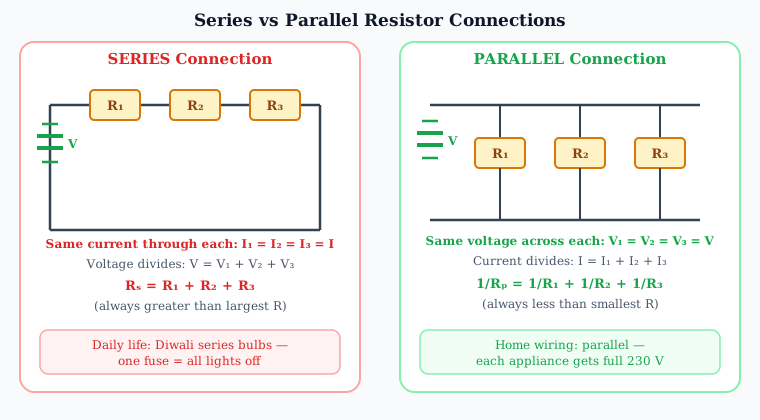
When resistors are connected end-to-end so that the same current flows through each one, they are said to be connected in series. The key features of a series circuit are: (1) Current is the same through every component — the current has no choice but to flow through each resistor one after another. (2) Potential difference (voltage) divides across the resistors — the sum of voltage drops equals the total applied voltage (Kirchhoff's voltage law). (3) Equivalent resistance equals the sum of individual resistances — the total resistance is always greater than the greatest individual resistance.
Why series circuits are rarely used in homes: If any component in a series circuit fails (burns out), the entire circuit breaks and all other components stop working. This is why decorative lights (serial bulbs used during Diwali in India) that use series connection go completely dark when one bulb fuses. Additionally, each component receives only a fraction of the total voltage.
Numerical example: Three resistors of 4 Ω, 6 Ω, and 10 Ω are in series across a 40 V battery. Find total resistance, total current, and voltage across each resistor. R_total = 4 + 6 + 10 = 20 Ω. I = V/R = 40/20 = 2 A (same current through all). V₁ = I × R₁ = 2 × 4 = 8 V. V₂ = 2 × 6 = 12 V. V₃ = 2 × 10 = 20 V. Check: 8 + 12 + 20 = 40 V. ✓
Resistors in Parallel — Theory and Numericals
When resistors are connected side by side between the same two points, they are said to be in parallel. The key features of a parallel circuit are: (1) Potential difference (voltage) is the same across every branch — each component receives the full supply voltage. (2) Current divides among the branches — higher-resistance branches get less current (I = V/R). (3) Equivalent resistance is found using the reciprocal formula — the total resistance is always less than the smallest individual resistance.
Why parallel connections are used in homes: All domestic appliances in India are connected in parallel. This means each appliance (fan, TV, refrigerator, air conditioner) operates at the same supply voltage (230 V AC in India). If one appliance fails, others keep working normally. Independent switching is possible — you can turn off a fan without affecting the lights. The main disadvantage is that more current is drawn as more appliances are switched on.
Numerical example: Two resistors of 6 Ω and 12 Ω are connected in parallel across a 12 V battery. Find equivalent resistance, total current, and current through each branch. 1/R_p = 1/6 + 1/12 = 2/12 + 1/12 = 3/12 = 1/4. R_p = 4 Ω. Total current I = V/R_p = 12/4 = 3 A. I₁ (through 6 Ω) = V/R₁ = 12/6 = 2 A. I₂ (through 12 Ω) = V/R₂ = 12/12 = 1 A. Check: I₁ + I₂ = 2 + 1 = 3 A = total current. ✓
Heating Effect of Current — Joule's Law
When current flows through a conductor with resistance, electrical energy is converted into heat energy. This is because free electrons collide with atoms in the conductor, transferring kinetic energy to the atoms, which then vibrate more vigorously — we detect this as heat.
Joule's law of heating: The heat produced in a conductor is directly proportional to (1) the square of the current (H ∝ I²), (2) the resistance of the conductor (H ∝ R), and (3) the time for which current flows (H ∝ t). Combining: H = I²Rt.
Practical applications using heating effect: Electric iron — nichrome wire heats up and iron plate transfers heat to clothes. Electric geyser — nichrome element heats water (a 2000 W geyser heats water faster than a 1000 W immersion rod). Electric toaster — browning bread by radiated heat from a hot element. Electric kettle — heating water quickly. Room heater — nichrome coil radiates heat into the room. All these are standard Indian household appliances. The heating effect is also the basis of electric fuses — a fuse wire melts and breaks the circuit when current exceeds the safe limit.
The same heating effect is also undesirable in transmission lines — power lines carrying current from power stations (like NTPC plants in India) to cities heat up and waste energy as heat. This is why high-voltage, low-current transmission is preferred for long distances (since H = I²Rt, reducing current greatly reduces heating loss).
Electric Power and Commercial Unit of Energy
Electric power is the rate at which electrical energy is consumed or converted into other forms of energy. A 100 W bulb converts 100 J of electrical energy into light and heat every second. A 2000 W geyser converts 2000 J per second.
Power can be expressed in three useful equivalent forms using Ohm's law: P = VI (most direct — voltage times current), P = I²R (useful when I and R are known), P = V²/R (useful when V and R are known).
Commercial unit of electrical energy is the kilowatt-hour (kWh). 1 kWh = 1000 W × 3600 s = 3.6 × 10⁶ J. This is the unit of electricity sold to consumers and measured by the meter in your home. In India, the electricity meter in every household records consumption in kWh (units). The electricity board charges per unit. If a family in Delhi uses appliances totalling 5 kW for 8 hours per day, their daily consumption is 5 × 8 = 40 units (kWh).
Example: A 100 W bulb burns for 5 hours. Energy consumed = P × t = 100 W × 5 h = 500 Wh = 0.5 kWh = 0.5 units. If electricity costs ₹8 per unit, cost = 0.5 × 8 = ₹4.
Rated power and rated voltage: Every appliance has a rated power and a rated voltage printed on it (like 60 W, 230 V). These are the conditions under which it operates normally. The resistance of the appliance at rated conditions = V²/P = 230²/60 ≈ 882 Ω.
Common Mistakes to Avoid
Adding resistances in parallel directly — always use the reciprocal formula for parallel: 1/R_p = 1/R₁ + 1/R₂. The equivalent parallel resistance is always less than the smallest resistance.
Connecting the voltmeter in series or the ammeter in parallel in circuit diagrams. Ammeter goes in series (it has low resistance); voltmeter goes in parallel (it has high resistance).
Using P = VI but substituting resistance instead of current — read the question carefully to identify which quantities are given before choosing the power formula.
Forgetting to convert time to seconds when calculating energy in joules (E = Pt requires t in seconds), or forgetting to convert watt-hours to kilowatt-hours when calculating electricity bills.
Thinking that connecting more resistors in parallel always increases the total resistance — it decreases it. More parallel paths mean less overall resistance.
Practice and Revision
Test your understanding with quick chapter-level practice.
Chapter Q&A
Why are household appliances connected in parallel and not in series?
In parallel: (1) Each appliance gets the full supply voltage (230 V in India), so it operates at its rated power. (2) Each appliance can be switched on/off independently. (3) If one appliance fails, others continue to work. In series, voltage divides, appliances would not work at rated power, and failure of one breaks the whole circuit.
What is the difference between electrical energy and electric power?
Electric power is the rate of doing work or converting energy: P = energy/time (unit: watt). Electrical energy is the total work done or energy converted in a given time: E = P × t (unit: joule or kWh). Power tells how fast; energy tells how much total.
Why is a thick copper wire better than a thin copper wire for carrying high current?
A thicker wire has a larger cross-sectional area, giving lower resistance (R = ρl/A). Lower resistance means less energy is wasted as heat (H = I²Rt), and the wire can carry more current without overheating. That is why high-current circuits use thicker wires.
What is short circuit? Why is it dangerous?
A short circuit occurs when the live and neutral wires (or two points in a circuit with very different potentials) are connected directly with negligible resistance — often due to damaged insulation. This causes a very large current to flow (I = V/R; R ≈ 0, so I → very large). The huge current can melt wires, cause fires, and damage appliances. Fuses and MCBs protect against short circuits.
How is a fuse different from an MCB?
A fuse is a thin wire with low melting point that melts and breaks the circuit when excess current flows — it is destroyed and must be replaced. An MCB (Miniature Circuit Breaker) is an automatic electromagnetic switch that trips and breaks the circuit when current exceeds the safe limit — it can be reset by flipping the switch back up. MCBs are more reliable, faster, and reusable; fuses are cheaper. Modern Indian homes increasingly use MCBs.
Why does the resistance of a metallic conductor increase with temperature?
In metals, as temperature increases, the atoms vibrate with greater amplitude. This increases the frequency of collisions between free electrons (charge carriers) and the vibrating atoms, impeding the electron flow more. More collisions mean more opposition to current — higher resistance.
Ad slot placed after the chapter body so reading flow is never interrupted.
This inventory appears across Class 9 and Class 10 notes so ads remain visible throughout the study journey.