Ad placement reserved for chapter sponsors, education tools, test prep platforms, and student offers.
The Human Eye and the Colourful World Notes
Complete Class 10 Science notes on the human eye — detailed structure and functions of each part, power of accommodation, near point and far point, all three major vision defects (myopia, hypermetropia, presbyopia) with causes and corrections, dispersion by prism, formation of rainbow, atmospheric refraction, twinkling of stars, advance sunrise, scattering of light, Tyndall effect, and why the sky is blue and sunsets are red.
- 18 min read
- 30 practice questions
- Aligned to CBSE 2025–26 syllabus
- 100% free · no login
- Updated Aug 2026
Reserved space for student-focused ads, learning tools, scholarships, and exam prep promotions.
Why This Chapter Is a Board Goldmine
This chapter applies the optics concepts from the previous chapter (Light) to the human eye and to stunning natural phenomena. Because many questions follow fixed patterns — part name and function, defect name and correction, phenomenon and reason — with thorough revision students can answer almost every question here perfectly.
Board questions from this chapter commonly include: labelled diagram of the human eye (3–5 marks), defect-of-vision explanation with ray diagram (3–5 marks), one-mark MCQ or fill-in-the-blank on near point/far point, dispersion and scattering reasoning (2–3 marks). This chapter rewards students who know the correct technical vocabulary and can use it precisely.
Simple Examples Before the Technical Terms
When you shift your eyes from a distant building to the page of a notebook, the eye adjusts focus automatically. You do not feel the lens moving, but the eye is actually changing its focal length. This is the easiest natural example of power of accommodation.
A student sitting in the last bench who can read the notebook clearly but struggles to read the blackboard is showing a simple real-life case of myopia. On the other hand, an older person who keeps the newspaper farther away to read it comfortably shows the idea behind hypermetropia or presbyopia. These are much easier to remember when attached to people we actually observe.
At sunset, the Sun looks reddish and the sky can show beautiful orange tones. During the day the sky looks blue, and stars seem to twinkle at night. These are not separate random facts; they all belong to the same chapter because the eye and light together explain them.
Structure of the Human Eye — Every Part Explained
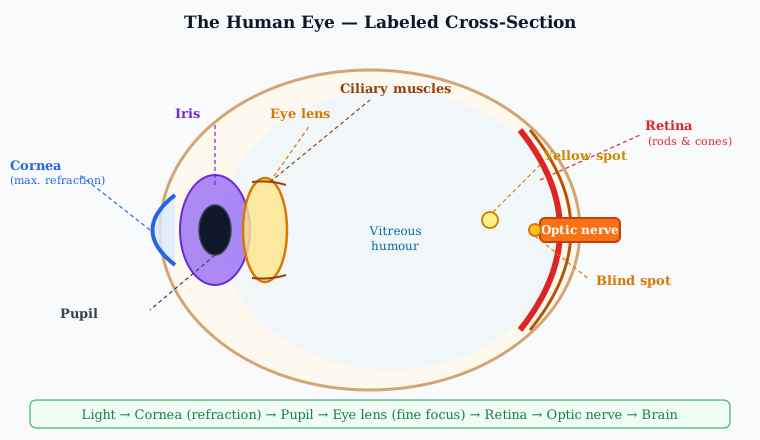
The human eye is a natural optical instrument that works on the same principle as a camera. It forms a real, inverted, and diminished image of the object on a light-sensitive screen called the retina. The brain then interprets this image correctly.
The Cornea is the transparent, dome-shaped front surface of the eye. It is responsible for most of the refraction of incoming light — about two-thirds of the total bending. It has no blood vessels and gets oxygen from the air. When a surgeon performs LASIK surgery (common in Indian cities), they reshape the cornea to correct vision.
The Iris is the coloured part of the eye (brown in most Indians). It is a muscular diaphragm that controls the size of the pupil. In bright light, the iris contracts to make the pupil smaller, reducing light entry. In dim light, it expands to enlarge the pupil and let in more light.
The Pupil is the dark circular opening at the centre of the iris through which light enters. It is not a structure itself but an opening. Its diameter can change from about 2 mm in bright light to about 8 mm in darkness.
The Eye Lens is a flexible, transparent, biconvex lens located just behind the pupil. It is made of a protein material and can change its curvature. It is responsible for fine-tuning the focus of images on the retina.
The Ciliary Muscles surround and are attached to the eye lens via suspensory ligaments. When these muscles contract, the lens becomes thicker and more curved (increased converging power, shorter focal length) for focusing on nearby objects. When they relax, the lens becomes thinner and flatter (longer focal length) for distant objects.
The Retina is the innermost, light-sensitive layer lining the back of the eye. It contains about 120 million rod cells (which detect light intensity and work in dim light — responsible for black-and-white vision) and about 6 million cone cells (which detect colour and work in bright light — responsible for colour vision). The image formed on the retina is real and inverted; the brain flips it to perceive the world correctly.
The Optic Nerve carries electrical signals from the retina to the visual cortex of the brain. The point where the optic nerve exits the eye has no photoreceptors and is called the blind spot — images falling on this point cannot be seen.
The Vitreous Humour is the clear, jelly-like fluid that fills the space between the lens and the retina, maintaining the shape of the eyeball. The Aqueous Humour is the watery fluid between the cornea and the lens that provides nutrients to the cornea and lens.
Power of Accommodation — Near Point and Far Point
The ability of the eye lens to change its focal length in order to focus clearly on objects at different distances is called the power of accommodation. This is achieved by the ciliary muscles changing the curvature of the eye lens.
When you look at a distant tree (far object): the ciliary muscles relax, the suspensory ligaments become taut, the eye lens flattens and becomes thinner, the focal length increases, and the converging power decreases just enough to bring the image of the tree onto the retina.
When you look at this page of notes (near object): the ciliary muscles contract, the suspensory ligaments loosen, the eye lens becomes thicker and more curved, the focal length decreases, and the converging power increases to bring the image of the text onto the retina.
The near point is the closest point at which the eye can see an object clearly without strain. For a normal young adult, this is about 25 cm. The near point moves farther as a person ages and the eye lens becomes less flexible. The far point is the farthest point at which the eye can see an object clearly. For a normal eye, the far point is at infinity — meaning a healthy eye can focus on very distant objects.
Myopia (Short-Sightedness) — Cause, Image, Correction
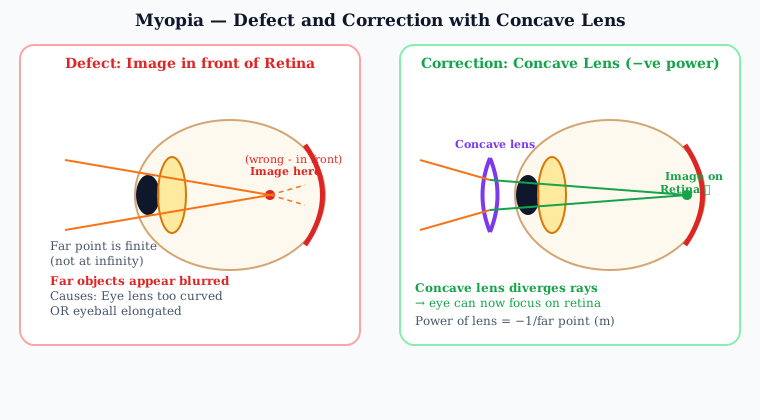
Myopia, also called short-sightedness or near-sightedness, is a defect in which a person can see nearby objects clearly but cannot see distant objects clearly. Distant objects appear blurred.
What goes wrong: In a myopic eye, parallel rays from a distant object converge and form the image in front of the retina instead of exactly on it. By the time light reaches the retina, the rays have already crossed and begun to diverge, forming a blurred patch instead of a sharp point.
Causes of myopia: (1) The eye lens is too converging (excessive curvature of the eye lens). (2) The eyeball is too elongated (longer than normal from front to back), so the retina is farther back than the focal point. Both causes result in the image forming in front of the retina.
Far point of a myopic eye: The far point is not at infinity — it is at some finite distance in front of the eye (for example, 2 m or 3 m). The person can see clearly only up to this distance.
Correction: A concave (diverging) lens is used. The concave lens diverges the incoming parallel rays from a distant object so that they appear to come from the far point of the myopic eye. The eye can then converge these diverged rays onto the retina, producing a clear image. The power of the corrective concave lens equals the reciprocal of the far point distance (with negative sign, in metres).
Indian context: In Indian cities, myopia has increased significantly due to more time spent indoors on screens and reduced outdoor activity. Ophthalmologists in India commonly prescribe concave lens spectacles for schoolchildren diagnosed with myopia.
Hypermetropia (Long-Sightedness) — Cause, Image, Correction
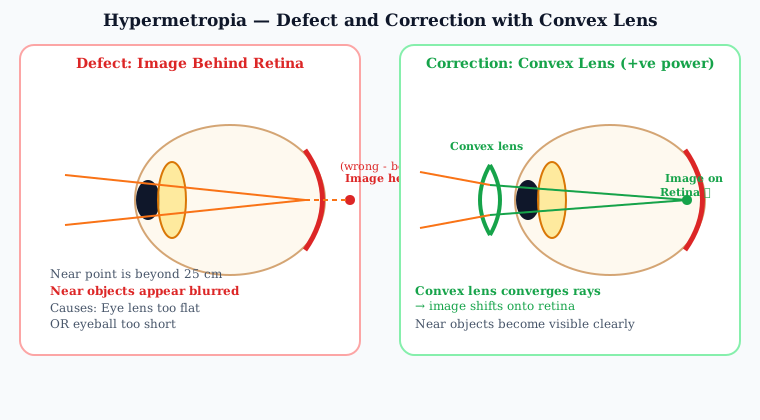
Hypermetropia, also called long-sightedness or far-sightedness, is a defect in which a person can see distant objects clearly but cannot see nearby objects clearly. Reading small text or threading a needle is difficult.
What goes wrong: In a hypermetropic eye, rays from a nearby object would converge behind the retina — the eye does not converge them enough to bring the image onto the retina. The eye lens is not converging (curved) enough, or the eyeball is too short.
Causes of hypermetropia: (1) The focal length of the eye lens is too large (lens is too flat, not curved enough). (2) The eyeball is too short (distance between lens and retina is less than normal), so the retina is closer to the lens than the focal point.
Near point of a hypermetropic eye: The near point is farther than 25 cm — the person must hold books and objects farther away to see them clearly.
Correction: A convex (converging) lens is used. It converges the rays from a nearby object and makes them appear to come from the near point of the normal eye (25 cm) or farther, so the hypermetropic eye can bring them to focus on the retina. The power of the corrective convex lens is positive.
Common confusion: Many students mix up myopia and hypermetropia. Memory tip — myopia = M = Minus = concave lens with negative power. Hypermetropia = H = Higher power needed = convex lens with positive power.
Presbyopia and Cataract
Presbyopia is an age-related defect of vision in which the power of accommodation of the eye decreases because the ciliary muscles weaken and the eye lens loses its flexibility. It usually appears after the age of 40–45 years.
In presbyopia, the near point moves farther away, making it difficult to read fine print. Many elderly people in India hold newspapers at arm's length to be able to read — this is a classic sign of presbyopia. The far point may also be affected in some individuals.
Correction: Convex lenses (reading glasses) are used for near vision. People with both myopia and presbyopia need bifocal lenses — the upper portion is concave (for distance) and the lower portion is convex (for reading). Progressive lenses (variable power lenses) gradually change from one power to the other and are becoming popular in Indian cities.
Cataract is a condition in which the eye lens becomes progressively opaque or cloudy, blocking or scattering light and causing blurred or milky vision. It is not corrected by spectacles. The only treatment is surgical removal of the cloudy lens and replacement with an artificial intraocular lens (IOL). Cataract surgery is one of the most common and successful surgeries performed in India, even in rural areas through government eye camps.
Dispersion of Light by a Prism
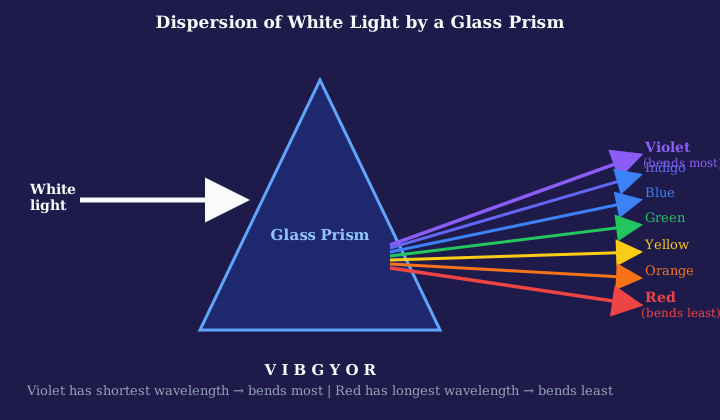
When white light passes through a glass prism, it splits into a band of seven colours called a spectrum. This splitting of white light into its constituent colours is called dispersion.
Why does dispersion happen? White light is actually a mixture of seven colours — Violet, Indigo, Blue, Green, Yellow, Orange, Red (remembered as VIBGYOR). Each colour has a different wavelength. When light enters glass, different wavelengths travel at slightly different speeds and therefore bend (refract) by slightly different amounts. Violet light bends the most and red light bends the least. This different bending separates the colours.
In a prism, light is refracted twice — once entering the prism and once leaving it. Both refractions cause dispersion, and the two refractions together spread the colours into a wide, visible spectrum.
Memory trick for colours and bending: VIBGYOR — V (violet) at top of list bends most; R (red) at bottom bends least. In terms of wavelength, red has the longest wavelength and violet the shortest. In terms of frequency, violet has highest frequency and red lowest.
If two identical prisms are placed in inverted positions, the second prism can recombine the dispersed spectrum back into white light. Newton demonstrated this with two prisms — proving that white light is a mixture of all colours, not that the prism adds colour.
Rainbow Formation
A rainbow is a natural spectrum of sunlight formed in the sky when sunlight is dispersed by tiny water droplets suspended in the atmosphere after rain or in a waterfall spray.
Inside each water droplet, three optical events occur: (1) Refraction as sunlight enters the droplet — this causes dispersion into colours. (2) Total internal reflection at the back surface of the droplet. (3) Refraction again as light exits the droplet — this causes further dispersion.
The result is that different colours emerge from the droplet at slightly different angles. Red light emerges at about 42° to the incident direction, and violet at about 40°. When you look at a rainbow, red is always at the top and violet at the bottom.
Conditions to see a rainbow: The Sun must be behind the observer. Rain or water droplets must be in front of the observer. A rainbow is always seen in the part of the sky opposite to the Sun. The best time to see a rainbow in India is in the late afternoon during or after a monsoon shower — Sun in the west and rain clouds in the east.
A double rainbow (seen occasionally) shows an outer bow where the order of colours is reversed (violet outside, red inside) because of an extra internal reflection inside the droplet.
Atmospheric Refraction — Twinkling Stars and Advance Sunrise
Earth's atmosphere is not uniform — it has layers of different temperatures and densities. Warmer air is less dense and cooler air is more dense. Light bends as it passes through these layers of continuously changing density. This bending of light due to the Earth's atmosphere is called atmospheric refraction.
Twinkling of stars: Stars are so far away that they appear as point sources of light. Starlight entering the atmosphere travels through layers of continuously changing density and temperature. The refractive index of these layers keeps changing due to atmospheric turbulence. As a result, the apparent position of the star changes rapidly and randomly, and its brightness also fluctuates. We see this as the star appearing to twinkle or scintillate.
Why planets do not twinkle (noticeably): Planets are much closer to Earth than stars and appear as small extended discs rather than point sources (though the discs are too small to be seen with the naked eye). Atmospheric fluctuations affect different points of this disc differently and the effects average out, so the apparent brightness does not fluctuate significantly. Planets appear steadier than stars.
Advance sunrise and delayed sunset: Due to atmospheric refraction, we see the Sun about 2 minutes before it actually rises above the horizon and for about 2 minutes after it has actually set below the horizon. When the Sun is near the horizon, light from it travels through a much thicker layer of atmosphere at a low angle and gets refracted (bent) significantly. The image of the Sun appears above the horizon even when the actual Sun is geometrically below it. This extends the day by about 4 minutes at the equinoxes.
Oval shape of the Sun at sunrise and sunset: When the Sun is at the horizon, the lower edge of the Sun is refracted more than the upper edge (because lower rays pass through a denser atmospheric layer). This unequal refraction makes the Sun appear flattened into an oval shape at sunrise and sunset.
Scattering of Light — Tyndall Effect, Blue Sky, Red Sunset
When light travels through a medium containing fine particles (like dust, smoke, or colloidal particles), the particles scatter the light in different directions. This redirection of light by particles is called scattering.
Tyndall Effect: When a beam of light passes through a colloidal solution or a suspension of fine particles, the path of light becomes visible because the particles scatter light sideways. This is called the Tyndall effect, named after physicist John Tyndall. Examples in Indian daily life: the beam of a torch or car headlight becomes visible in dusty or foggy conditions; sunlight entering through a small gap in a shutter in a dusty room makes the beam visible; and the beams of headlights on winter mornings in Delhi or North India are visible because of fog and dust particles in the air.
Why the sky is blue: The atmosphere contains gas molecules and fine particles. These particles are very small — comparable to or smaller than the wavelength of visible light. Such small particles scatter shorter wavelengths much more strongly than longer wavelengths (this is called Rayleigh scattering — scattering intensity is inversely proportional to the fourth power of wavelength). Blue light has a shorter wavelength than red, yellow, or orange light and is therefore scattered most in all directions across the sky. An observer on the ground looking at any part of the sky sees this scattered blue light, making the entire sky appear blue.
Why the Sun appears red or orange at sunrise and sunset: When the Sun is near the horizon, sunlight travels through a much longer path of dense atmosphere to reach the observer. Over this long path, most of the blue and violet light is scattered away in other directions and does not reach the observer's eye. Only the longer-wavelength colours — red, orange, and yellow — remain in the direct beam and reach the observer. This is why the Sun appears red or deep orange at sunrise and sunset. The Moon and stars also appear reddish when near the horizon for the same reason.
Why the sky appears dark from space: Astronauts in the ISS or in the Chandrayaan spacecraft looking outward from Earth see a black sky because there are no particles to scatter sunlight — scattering only occurs within the atmosphere.
Common Mistakes to Avoid
Writing that myopia is corrected by a convex lens — it is always corrected by a concave lens. Only hypermetropia requires a convex lens.
Confusing near point and far point: the near point is the closest distance for clear vision; the far point is the farthest. For a myopic eye, the far point is finite (not infinity). For a hypermetropic eye, the near point is beyond 25 cm.
Saying the cornea is just a transparent cover — always add that it causes the maximum refraction in the eye (about two-thirds of total bending).
Writing that planets twinkle like stars — planets generally do not twinkle noticeably because they subtend a small but finite angular disc, unlike stars which are true point sources.
Explaining blue sky by saying 'blue is the most visible colour' — always say that blue light has a shorter wavelength and is scattered much more than red or other longer-wavelength light by atmospheric particles.
Saying 'dispersion happens because colours have different wavelengths' without completing the reasoning — the correct explanation is that different wavelengths travel at different speeds in glass and therefore refract by different amounts.
Practice and Revision
Test your understanding with quick chapter-level practice.
Chapter Q&A
How should I answer a defect-of-vision question for full marks?
Follow this pattern for 5 marks: (1) Name the defect. (2) State what the person can and cannot see clearly. (3) State where the image forms (in front of or behind the retina). (4) Give two causes. (5) State the corrective lens. (6) Draw a neat labelled ray diagram showing the defect and the correction.
What is the difference between the near point and the least distance of distinct vision?
They are the same thing. The near point of a normal human eye is about 25 cm, which is also called the least distance of distinct vision (D). Objects closer than this appear blurred because the eye's ciliary muscles cannot increase the lens curvature further.
Why does the eye lens need to be flexible?
The eye lens must change its focal length rapidly to focus on objects at different distances — this is the power of accommodation. If the lens were rigid (as happens with age in presbyopia), it could only focus at one fixed distance. Flexibility, controlled by ciliary muscles, allows the same lens to serve near and far vision.
Can a person have both myopia and hypermetropia?
Yes. As a person ages, they may develop presbyopia along with pre-existing myopia or hypermetropia. In such cases, bifocal spectacles are prescribed: the upper portion corrects distance vision (concave for myopic) and the lower portion corrects near vision (convex for near reading). Progressive lenses provide a gradual change in power.
What does VIBGYOR stand for and which colour bends most?
VIBGYOR stands for Violet, Indigo, Blue, Green, Yellow, Orange, Red — the seven colours of the visible spectrum. Violet bends (deviates) the most in a prism because it has the shortest wavelength and the highest refractive index in glass. Red bends the least because it has the longest wavelength.
Why is there no Tyndall effect in a clear solution like salt water?
The Tyndall effect requires particles that are large enough to scatter visible light (particle size comparable to wavelength of light, i.e., about 400–700 nm). In a true solution like salt water, the dissolved ions are only a few angstroms in size — far too small to scatter visible light effectively. So the path of a light beam is not visible in a true solution. It is visible in colloidal solutions or suspensions.
Why do we sometimes see stars near the horizon that are not actually there yet?
Due to atmospheric refraction, light from a star just below the horizon bends towards the Earth's surface as it travels through increasingly dense air layers. This bending makes the star appear to be above the horizon even when it is geometrically below it. The star's apparent position is thus shifted upward from its actual position.
Ad slot placed after the chapter body so reading flow is never interrupted.
This inventory appears across Class 9 and Class 10 notes so ads remain visible throughout the study journey.