Ad placement reserved for chapter sponsors, education tools, test prep platforms, and student offers.
Light – Reflection and Refraction Notes
Comprehensive Class 10 Science notes on light — covering laws of reflection, plane and spherical mirrors, image formation tables for all object positions, New Cartesian sign convention, refraction, Snell's law, refractive index, glass slab, convex and concave lenses, lens formula, magnification, power of lens, and full numerical practice with step-by-step answers.
- 21 min read
- 34 practice questions
- Aligned to CBSE 2025–26 syllabus
- 100% free · no login
- Updated Aug 2026
Reserved space for student-focused ads, learning tools, scholarships, and exam prep promotions.
How Light Travels and Why This Chapter Matters
Light is a form of energy that travels in straight lines in a uniform transparent medium. This straight-line travel is called rectilinear propagation and explains why shadows are sharp and why a pinhole camera works. When light meets a surface or enters a different medium, two major events can occur: reflection (bouncing back) or refraction (bending due to change in speed).
In CBSE Class 10 board exams, this chapter contributes heavily to both theory and numerical sections. Students are tested on ray diagrams (2–3 marks each), sign-convention-based numericals (3–5 marks), image properties (1–2 marks), and application-based questions about mirrors and lenses in daily life. Mastering this chapter well practically guarantees full marks in the optics portion.
Simple Examples That Make Light Easy
When sunlight enters a room through a small gap in the window, it appears as a straight bright beam in dusty air. This everyday sight is one of the simplest ways to remember that light travels in straight lines. The same idea explains why shadows are formed behind objects.
Look at your face in a mirror while getting ready for school or college. The light from your face reaches the mirror and bounces back to your eyes, so you see your image. This is the easiest example of reflection because it happens in daily life without any laboratory setup.
Now place a pencil in a glass of water and observe it from the side. The pencil appears bent near the water surface because light changes direction while moving from water to air. This single home experiment makes refraction much easier to understand before the formulas begin.
Laws of Reflection
Reflection is the bouncing back of light when it hits a polished or shiny surface. The surface can be flat like a plane mirror, or curved like a shiny spoon or the back of a stainless steel thali used in Indian homes.
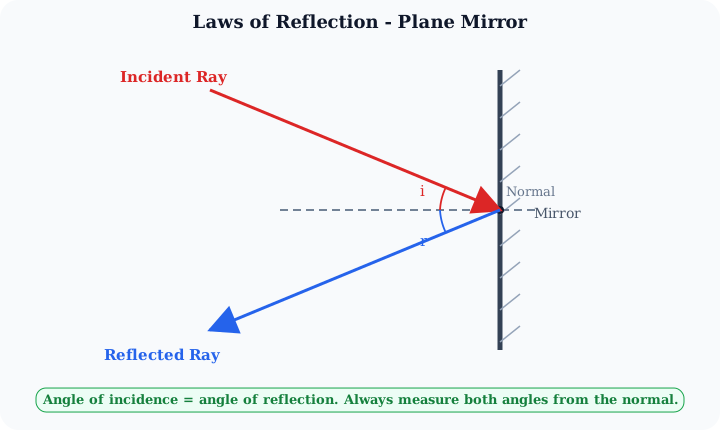
The two laws of reflection are absolute and apply to all types of reflective surfaces: First, the angle of incidence is always equal to the angle of reflection — both measured from the normal at the point of incidence, not from the mirror surface. Second, the incident ray, the reflected ray, and the normal to the mirror at the point of incidence all lie in the same plane.
A critical exam trap: students often measure angles from the mirror surface instead of from the normal. If the mirror makes 30° with the incident ray, the angle of incidence is 60°, not 30°. Always construct the normal first, then measure.
Plane Mirror — Image Properties in Full Detail
A plane mirror is a flat, smooth, highly polished reflective surface. When you look into a plane mirror — like the bathroom mirror every morning — you see an image that appears to be behind the mirror. This image has very specific properties that the board exam tests repeatedly.
The image formed by a plane mirror is always virtual (light rays do not actually pass through the image point), erect (same way up as the object), and of the same size as the object. The image distance behind the mirror exactly equals the object distance in front of the mirror. The image is laterally inverted, which means left and right appear swapped. This is why the word AMBULANCE is written in mirror script on the front of ambulances in India — when a car driver reads it in their rear-view mirror, it appears correctly and they know to move aside quickly.
If a person stands 2 metres in front of a plane mirror and walks towards it at 1 m/s, the image also moves towards the person at 1 m/s relative to the mirror, so the closing speed between person and image is 2 m/s. This relative speed concept appears in board numericals.
Spherical Mirrors — Types, Terms, and Definitions
A spherical mirror is a mirror whose reflecting surface forms part of a hollow sphere. There are two types. A concave mirror has its reflecting surface on the inner (cave) side of the sphere — like the inside of a shiny bowl. A convex mirror has its reflecting surface on the outer (bulging) side — like the back of a shiny spoon or a dome-shaped security mirror in a shop.
Key terms you must know precisely for board answers: The Pole (P) is the geometric centre of the mirror surface. All distances are measured from P. The Centre of Curvature (C) is the centre of the imaginary full sphere of which the mirror is a part. The Radius of Curvature (R) is the distance from C to P — it equals the radius of that sphere. The Principal Axis is the straight line passing through C and P. The Principal Focus (F) is the point on the principal axis where rays parallel to the axis converge after reflection (concave) or appear to diverge from after reflection (convex). The Focal Length (f) is the distance from P to F.
The most important relationship between focal length and radius of curvature is that R equals 2f, or equivalently f equals R divided by 2. For a concave mirror, the focus F lies in front of the mirror (real focus). For a convex mirror, the focus F lies behind the mirror (virtual focus). The aperture of a mirror is the diameter of the reflecting surface.
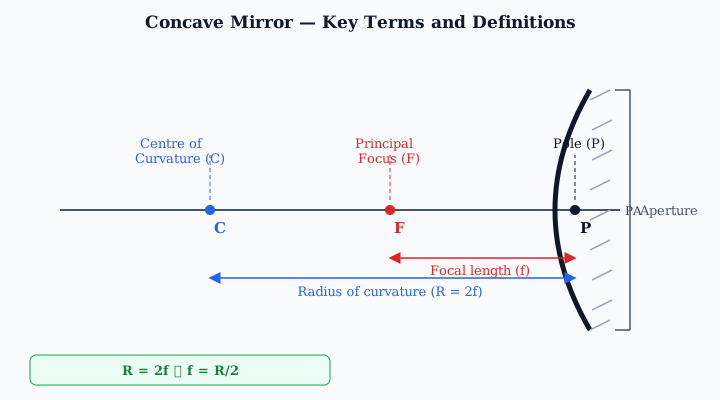
Image Formation by Concave Mirror — All Six Cases
The position and nature of the image formed by a concave mirror depend entirely on where the object is placed. There are six standard positions. You must know all six for board exams — ray diagram questions pick any one of these cases.
Case 1 — Object at infinity: Parallel rays from a very distant object (like the Sun) converge at the principal focus F. Image is at F, highly diminished (almost a point), real and inverted. Use: solar furnace, reflecting telescope.
Case 2 — Object beyond C: Image forms between C and F, is real, inverted, and smaller than the object (diminished). This is the most common ray diagram question.
Case 3 — Object at C: Image forms at C itself, is real, inverted, and exactly the same size as the object. This is the symmetric case — object and image swap positions.
Case 4 — Object between C and F: Image forms beyond C (farther from mirror than C), is real, inverted, and larger than the object (magnified). Use: projector idea.
Case 5 — Object at F: Reflected rays are parallel to the principal axis — they meet at infinity. Image forms at infinity, highly magnified, real and inverted. Use: torches, searchlights, and vehicle headlights — bulb placed at F so reflected beam is a parallel beam.
Case 6 — Object between F and P: This is the special case. Image forms behind the mirror, is virtual, erect, and magnified (enlarged). Use: shaving mirrors, dentist's mouth mirror, make-up mirrors. In India, the concave mirror inside a barber's or beauty salon's magnifying mirror works on this principle.
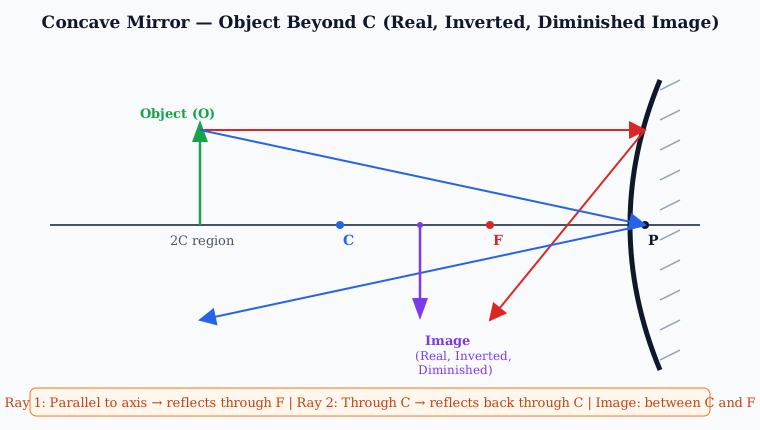
Image Formation by Convex Mirror
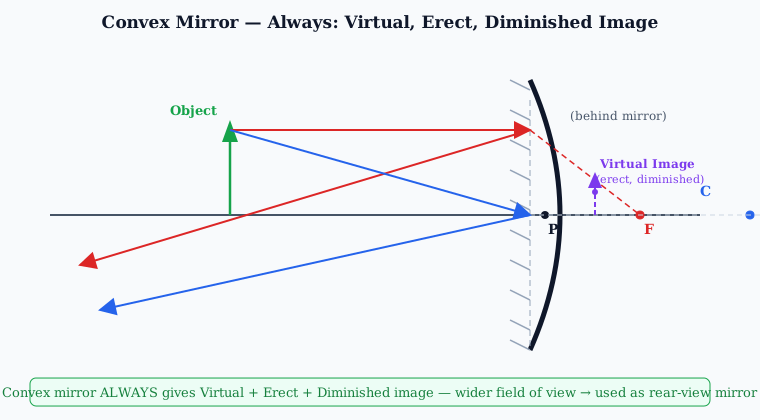
A convex mirror always forms one type of image regardless of where the object is placed: the image is always virtual, erect, and diminished (smaller than the object). The image always forms between the pole P and the focus F, behind the mirror.
Because the image is always smaller than the object, a convex mirror shows a wider field of view compared to a plane or concave mirror of the same size. This is exactly why convex mirrors are installed as rear-view mirrors in cars, buses, trucks, and two-wheelers on Indian roads — the driver can see a wider stretch of road behind the vehicle. They are also used as security mirrors in shops, at sharp road bends in hilly areas like Himachal Pradesh and Uttarakhand, and at ATM corners.
The limitation of convex mirrors is that the image appears smaller than the actual object, so distances and sizes are misjudged. Drivers must keep this in mind — objects seen in convex side mirrors are actually closer than they appear, which is why side mirrors in India often carry the warning 'Objects in mirror are closer than they appear'.
New Cartesian Sign Convention for Mirrors
The New Cartesian Sign Convention gives a consistent mathematical system for solving all mirror problems. The rules are: (1) All distances are measured from the pole P of the mirror. (2) Distances measured in the direction of the incident light (usually to the left of the mirror for light coming from the left) are positive. Distances measured opposite to incident light (behind the mirror or on the reflecting side) are negative in the conventional setup. More precisely in the standard convention: (3) The incident light travels from left to right. The principal axis goes from left to right. (4) Distances measured to the right of the pole are positive. Distances measured to the left of the pole are negative. (5) Heights measured above the principal axis are positive. Heights below are negative.
For a concave mirror: the object is placed to the left of the mirror, so object distance u is always negative. The focal length f is negative because F lies to the left of P (in front of the mirror). For a real image, v is also negative. For a virtual image (object between F and P), v is positive.
For a convex mirror: f is positive (F is behind the mirror, to the right of P). The virtual image has a positive v. The object distance u is always negative.
Common sign-convention mistakes that lose marks: writing f as positive for a concave mirror in a numerical, or forgetting that u is always negative for real objects.
Mirror Formula and Magnification — Worked Examples
The mirror formula connects object distance (u), image distance (v), and focal length (f). It applies to both concave and convex mirrors when sign convention is used correctly.
Example 1: An object is placed 30 cm in front of a concave mirror of focal length 15 cm. Find the image distance and magnification. Using sign convention: u = −30 cm, f = −15 cm. Applying 1/f = 1/v + 1/u gives 1/(−15) = 1/v + 1/(−30), so 1/v = −1/15 + 1/30 = −2/30 + 1/30 = −1/30, therefore v = −30 cm. The image is 30 cm in front of the mirror (real). Magnification m = −v/u = −(−30)/(−30) = −1. The image is the same size and inverted (m is negative and |m| = 1).
Example 2: An object is 10 cm in front of a convex mirror of focal length 15 cm. Find image distance. u = −10 cm, f = +15 cm. 1/v = 1/f − 1/u = 1/15 − 1/(−10) = 1/15 + 1/10 = 2/30 + 3/30 = 5/30, so v = +6 cm. Image is 6 cm behind the mirror, virtual and erect. m = −v/u = −6/(−10) = +0.6. Image is diminished and erect (positive m, |m| < 1).
Board answer tip: Always write the given data list, the formula, substitution with units, and the final answer with sign interpretation. Never skip the sign-convention declaration.
Refraction of Light — Concept and Laws
Refraction is the change in the direction of propagation of light when it passes obliquely from one transparent medium to another. The key reason is that the speed of light is different in different media. In vacuum and approximately in air, light travels at about 3 × 10⁸ m/s. In glass it travels slower, in water it travels slower than in air but faster than in glass.
When light goes from a rarer medium (like air) to a denser medium (like glass or water), it slows down and bends towards the normal at the boundary. When it goes from a denser to a rarer medium, it speeds up and bends away from the normal. When light hits a surface perpendicularly (along the normal), it passes through without bending.
Everyday examples of refraction in India: A pencil dipped in a glass of water appears bent at the water surface — a classic demonstration in science class. A coin placed at the bottom of a steel bucket appears raised and visible even though you could not see it when the bucket was empty — this is why swimming pools look shallower than they really are. When driving on a hot summer highway in Rajasthan or Gujarat, the road ahead appears shimmering and wet — this is a mirage caused by refraction of light in layers of hot air near the road surface.
The two laws of refraction are: First, the incident ray, the refracted ray, and the normal at the point of incidence all lie in the same plane. Second, for a given pair of media, the ratio of the sine of the angle of incidence to the sine of the angle of refraction is a constant. This constant is the refractive index of the second medium with respect to the first. This is called Snell's Law.
Refraction Through a Glass Slab
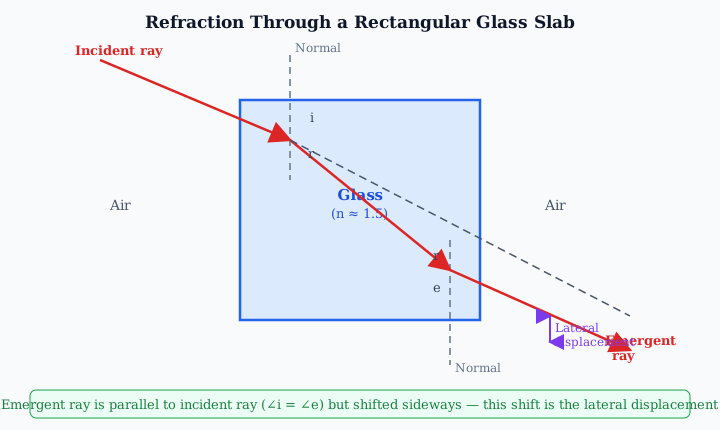
When light passes through a glass slab (a rectangular block of glass), it undergoes refraction twice — once when entering from air to glass, and once when leaving from glass to air. Because the two surfaces are parallel, the angle of incidence at the first surface equals the angle of emergence at the second surface.
The result is that the emergent ray is parallel to the incident ray — but it has shifted sideways. This sideways shift is called lateral displacement or lateral shift. The lateral displacement increases with the thickness of the slab and with the angle of incidence. At zero angle of incidence (ray hitting the slab straight on), there is no lateral displacement.
This is why objects viewed through a thick glass window pane in an old building appear slightly shifted compared to their actual position. The glass slab question is a favourite board question: students must draw the correct bending at each surface and show the lateral displacement clearly.
Spherical Lenses — Convex and Concave
A lens is a transparent optical device bounded by two curved surfaces (usually spherical). Lenses work by refraction. A convex lens (also called a converging lens) is thicker at the centre and thinner at the edges. A concave lens (also called a diverging lens) is thinner at the centre and thicker at the edges.
Key terms for lenses: Optical Centre (O) is the central point of the lens. A ray passing through O goes straight without bending. Principal Axis is the line through both centres of curvature. Principal Focus (F) for a convex lens is the point where parallel rays converge after refraction — it is a real focus. For a concave lens, parallel rays appear to diverge from F after refraction — it is a virtual focus. Focal Length (f) is the distance from O to F.
A convex lens has two real foci (F₁ on the left and F₂ on the right) at equal distances from O. A concave lens has two virtual foci. Power of a lens is the reciprocal of focal length in metres and is measured in dioptres (D). A convex lens has positive power and a concave lens has negative power.
Image Formation by Convex Lens — All Six Cases
Just like the concave mirror, the convex lens has six standard object positions giving different image results.
Case 1 — Object at infinity: Parallel rays converge at F₂. Image at F₂, real, inverted, highly diminished. Use: camera lens focused at distant subject, refracting telescope objective.
Case 2 — Object beyond 2F₁: Image between F₂ and 2F₂, real, inverted, diminished.
Case 3 — Object at 2F₁: Image at 2F₂, real, inverted, same size. The symmetric case for lenses.
Case 4 — Object between F₁ and 2F₁: Image beyond 2F₂, real, inverted, magnified (enlarged). Use: slide projector, overhead projector.
Case 5 — Object at F₁: Refracted rays are parallel, image at infinity, real, inverted, highly enlarged. Use: searchlight with bulb at focus.
Case 6 — Object between F₁ and O: Image on the same side as the object (left side), virtual, erect, magnified. Use: magnifying glass (simple microscope). A jeweller examining gems with a loupe, or a student reading with a magnifying glass, sees this virtual magnified image.
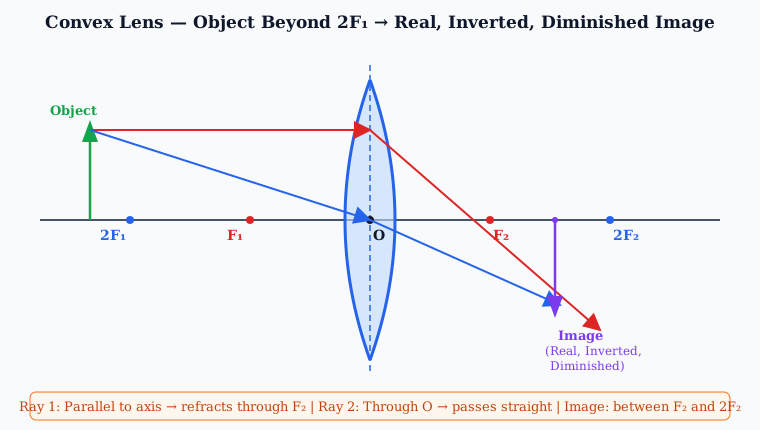
Image Formation by Concave Lens
A concave lens always forms a virtual, erect, and diminished image regardless of where the object is placed. The image always forms between the optical centre O and the principal focus F₁, on the same side as the object. This consistent behaviour makes concave lens questions simpler — you only need to confirm these three properties and calculate the position.
Practical use of concave lens: spectacles for people with myopia (short-sightedness). When a myopic person cannot see distant objects clearly, a concave lens of appropriate negative power is placed in front of the eye to diverge the incoming rays so that the eye lens can focus them on the retina. Door peepholes (spy holes) also use concave lenses to give a wide-angle view.
Lens Formula, Magnification, and Power — Full Treatment
The lens formula uses the same sign convention as the mirror formula, but the distances are measured from the optical centre O. For a lens, object distance u is always negative (object on the left). Focal length f is positive for convex and negative for concave. Image distance v is positive if image is on the right (real) and negative if on the left (virtual).
Example: A convex lens of focal length 20 cm has an object 30 cm to its left. Find image distance. u = −30 cm, f = +20 cm. Using lens formula: 1/v − 1/u = 1/f, so 1/v − 1/(−30) = 1/20, therefore 1/v + 1/30 = 1/20, giving 1/v = 1/20 − 1/30 = 3/60 − 2/60 = 1/60, so v = +60 cm. Image is 60 cm to the right of the lens — real and inverted. Magnification m = v/u = 60/(−30) = −2. Image is twice as large as the object and inverted.
Power of a lens is defined as P = 1/f where f is in metres. Unit is dioptre (D). A +2 D lens has f = 0.5 m = 50 cm and is convex. A −4 D lens has f = −0.25 m = −25 cm and is concave. When two thin lenses are placed in contact, their combined power equals the algebraic sum of individual powers: P = P₁ + P₂. A convex lens of +5 D combined with a concave lens of −3 D gives a combined power of +2 D.
How to Draw Ray Diagrams — Step-by-Step
Ray diagrams carry guaranteed marks in the board exam and are straightforward if you follow a fixed procedure.
For a mirror diagram: (1) Draw the principal axis as a horizontal line. Mark P at the centre of the mirror curve. (2) Draw the concave or convex mirror as a curved line at P, opening towards the left. (3) Mark C and F on the principal axis at distances R and f from P. (4) Draw the object as a vertical arrow above the axis at the given position. (5) Draw Ray 1: a ray parallel to the principal axis from the tip of the object — after reflection it passes through F (concave) or appears to come from F (convex). (6) Draw Ray 2: a ray from the tip of the object directed towards C — it hits the mirror and reflects straight back. (7) The intersection of reflected rays (or their extensions) gives the image tip. (8) Draw the image arrow from the axis to the image tip. Label all points.
For a lens diagram: (1) Draw the principal axis. Draw the thin lens as a vertical double-arrowed line at O. (2) Mark F₁ and F₂ at equal distances on each side of O. Also mark 2F₁ and 2F₂. (3) Draw the object arrow above the axis. (4) Draw Ray 1: parallel to axis from the tip — after refraction passes through F₂ (convex) or appears to come from F₁ (concave). (5) Draw Ray 2: from the tip through O — passes straight through without bending. (6) The intersection gives the image tip. Label everything including the nature of the image.
Common Mistakes to Avoid
Measuring angle of incidence from mirror surface instead of normal — this is the single most common error in ray diagrams and concept questions.
Writing R = f/2 instead of R = 2f. Always remember: radius of curvature is twice the focal length.
Using the mirror formula (1/f = 1/v + 1/u) for a lens question or vice versa (1/v − 1/u = 1/f). The key difference is the sign between 1/v and 1/u.
Forgetting sign convention: u is always negative for real objects. f is negative for concave mirrors and concave lenses; positive for convex mirrors and convex lenses.
Writing that a convex mirror gives a magnified image — it never does for a real object. It always gives a diminished image.
Not stating the three image properties (position, nature, size) when asked to describe an image.
Practice and Revision
Test your understanding with quick chapter-level practice.
Chapter Q&A
How do I know whether to use the mirror formula or the lens formula?
If the question involves a mirror (concave or convex), use the mirror formula: 1/f = 1/v + 1/u. If it involves a lens (convex or concave), use the lens formula: 1/f = 1/v − 1/u. The key difference is the sign between the two terms on the right-hand side.
What is the sign of focal length for a concave mirror?
Negative. In the New Cartesian sign convention, the focus of a concave mirror lies in front of the mirror (in the direction opposite to incident light when light comes from the left), so f is negative for a concave mirror.
When is the magnification positive and when is it negative for mirrors?
Magnification m = −v/u. For a real inverted image (real object, real image in front of the mirror), both v and u are negative, making m negative. For a virtual erect image (object between F and P of a concave mirror), v is positive and u is negative, making m positive.
Why does a concave mirror form both real and virtual images but a convex mirror only forms virtual images (for real objects)?
A concave mirror converges reflected rays, so they can actually meet (real image) or appear to diverge (virtual image when object is between F and P). A convex mirror always diverges reflected rays — they never actually meet in front of the mirror, so the image is always virtual (appears to form behind the mirror).
What is the difference between refraction and reflection?
In reflection, light bounces back into the same medium; the speed does not change. In refraction, light passes into a different medium and its speed changes, causing it to change direction. Reflection obeys the law ∠i = ∠r; refraction obeys Snell's law (sin i / sin r = constant).
Why is the power of a lens measured in dioptres and not in centimetres?
Power is defined as P = 1/f where f must be in metres. The dioptre (D) is the unit of power: 1 D = 1 m⁻¹. Using focal length in centimetres would give an inconsistent unit; converting to metres gives the standard dioptre unit used in all optometry prescriptions.
Can a convex lens ever produce a diminished image?
Yes. When the object is placed beyond 2F₁ of a convex lens, the image forms between F₂ and 2F₂ and is diminished (smaller than object), real, and inverted. When the object is at infinity, the image is at F₂ — highly diminished. Only when the object is between F₁ and O does the convex lens give a magnified (virtual) image.
How do I find the focal length of a concave mirror experimentally?
Hold the concave mirror facing a distant object (like a distant building or a bright window). Adjust the distance between the mirror and a screen (or a piece of white paper) until a sharp, clear, inverted image forms on the screen. This distance from the screen to the mirror is approximately equal to the focal length (since the distant object is approximately at infinity).
What is the difference between magnification of +2 and −2?
Both mean the image is twice the size of the object. m = +2 means the image is virtual, erect, and magnified (e.g., object between F and P of concave mirror). m = −2 means the image is real, inverted, and magnified (e.g., object between F and C of concave mirror).
Why does light bend towards the normal when going from air to glass?
Glass is optically denser than air, so light slows down when entering glass. This slowing causes the wavefront to tilt, bending the ray towards the normal. The degree of bending is quantified by Snell's law and the refractive index of glass.
Ad slot placed after the chapter body so reading flow is never interrupted.
This inventory appears across Class 9 and Class 10 notes so ads remain visible throughout the study journey.